Pharmacophores are one of the harder things to teach in pharmacy. A pharmacophore is the set of features on a drug molecule, arranged in a specific way in 3D, that lets it lock onto its biological target. Students have to take a flat chemical formula on paper and picture it as a shape in three dimensions. Most never get there, and the concept stays abstract.
We decided to turn it into a game.
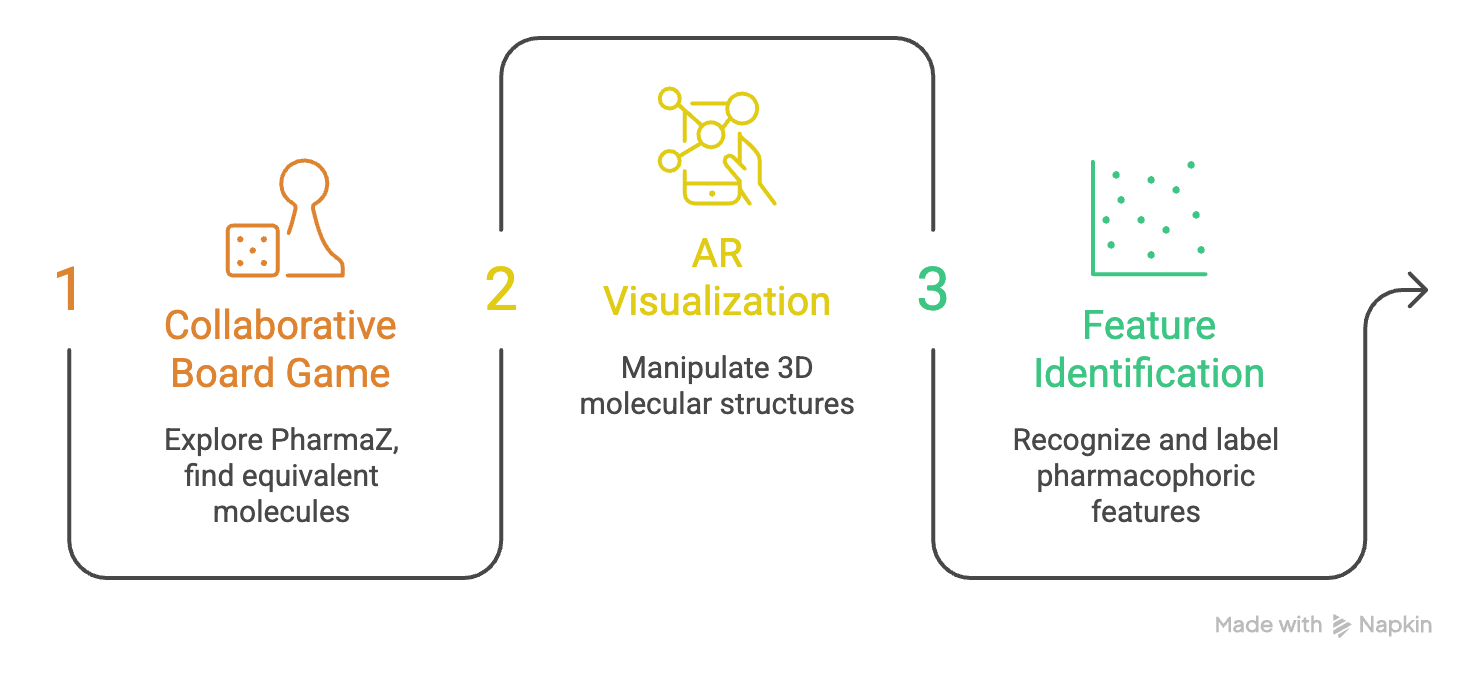
Escape from PharmaZ is a collaborative board game paired with a phone app called Nanoscope. The setup is a sci-fi escape: a crew of astronauts has crashed on an alien planet, several of them are injured, and the players have to explore the planet to find local molecules that match the drugs their crew needs. The catch is that "match" means matching the pharmacophore, not the formula. Two molecules can look completely different on paper and still do the same job.
This is where the Augmented Reality comes in. When a player flips a tile and scans it with Nanoscope, the 3D pharmacophore model appears floating over the table. You turn the tile, or move the phone, and you see the model from any angle, like a magnifying glass for something far too small to see. The rendering runs on UnityMol, the same molecular visualization engine we use in the lab.
A few design choices matter more than they look. The radio is "broken" in the story, so teams can only compare notes when their astronauts physically meet in the middle of the board. That forces people to talk: to name the features out loud, argue about whether a molecule fits, and use the right vocabulary. We suspected the talking would help. It turned out to be the heart of the whole thing.
We ran a first test with 24 volunteers, aged 15 to 57, from high-school students to professors. Everyone improved their score on pharmacophore questions after playing. The result I keep coming back to: before the game, the chemistry novices scored well below the experts, exactly as you would expect. After one session, the two groups could no longer be told apart. A single afternoon of play closed a gap that years of teaching struggle with.
It is a small study, with volunteers rather than a real class, so I would not over-read it. The AR clearly helped players grasp that a single feature can be a whole group of atoms, though it did less to convey how a molecule shifts shape as it moves. The obvious next step is a proper classroom trial with undergraduates.
Still, the basic bet held up. Give people something to touch and argue over, and an abstract 3D idea becomes something they can actually hold in their heads.