Can you build an aquaporin from scratch?
Our cells move water through natural protein pores called aquaporins, which let water through fast while keeping salt and other ions out. They are elegant, but fragile under the pressure and saltiness of a real desalination plant, so for years we have been building simpler, tougher stand-ins from small designed molecules. In our continuing work on these artificial water channels, this JACS paper asks how close we can get to the real thing.
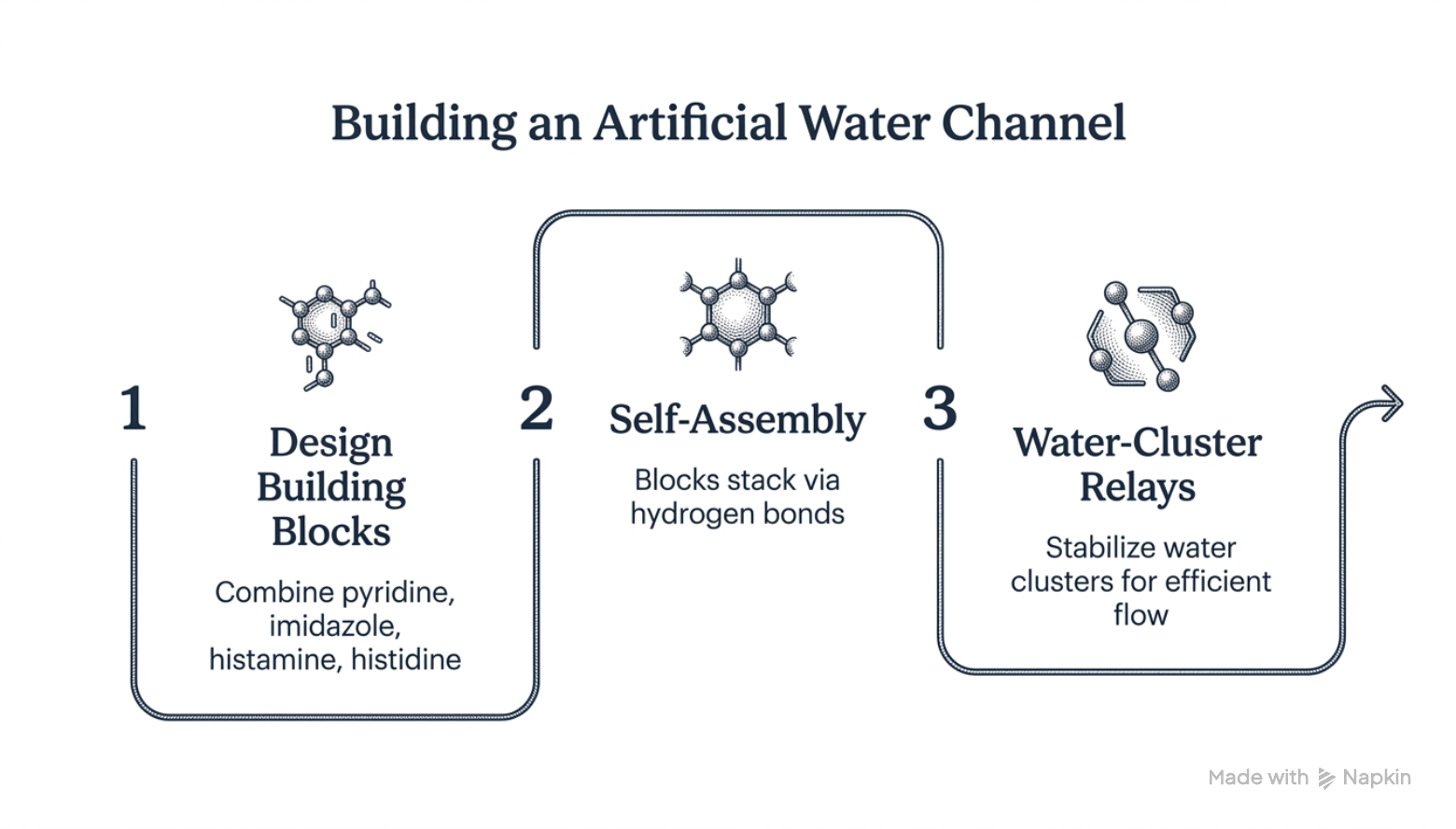
We combined a pyridine-2,6-dicarboxamide core with imidazole arms borrowed from histamine and histidine, making U-shaped building blocks. Left to themselves, these blocks stack into channels held together by many weak hydrogen bonds, the same gentle grip water uses to cling to the inside of aquaporins. The crystal structures show two kinds of channel: wide ones that cradle little clusters of water, and narrow ones that thread water in single-file wires.
The numbers surprised me. The best of these channels shuttles water at 1.2 x 10⁷ molecules per second per channel, only about ten times slower than a natural aquaporin. They also carry protons and turn ions away almost completely, which is exactly the behaviour you want for a desalination membrane.
On the modelling side, the simulations made the mechanism tangible. They showed the U-channels bundling into stable "porous sponges" once we dressed them with oily side chains, with the many hydrogen-bonding groups acting as relays that hand water clusters along inside the channel. Seeing the crystal structures, the transport measurements, and the simulations all point to the same water-cluster picture is what gave me confidence in the story.
The lesson I take from this: many weak bonds working together, not one strong site, is what makes a fast and salt-rejecting channel. And the shape of the building block is a real design knob, deciding whether the channel cradles clusters or threads single wires.
Work led by Mihail Barboiu and co-authors, funded by the ANR (BIOWATER and AQUAFOLDAMERS). Getting this close to an aquaporin with molecules you can make in a flask is a satisfying result.
Plain-language summary on Kudos: link.growkudos.com/1eeby0im77k